
Jesus: Our King
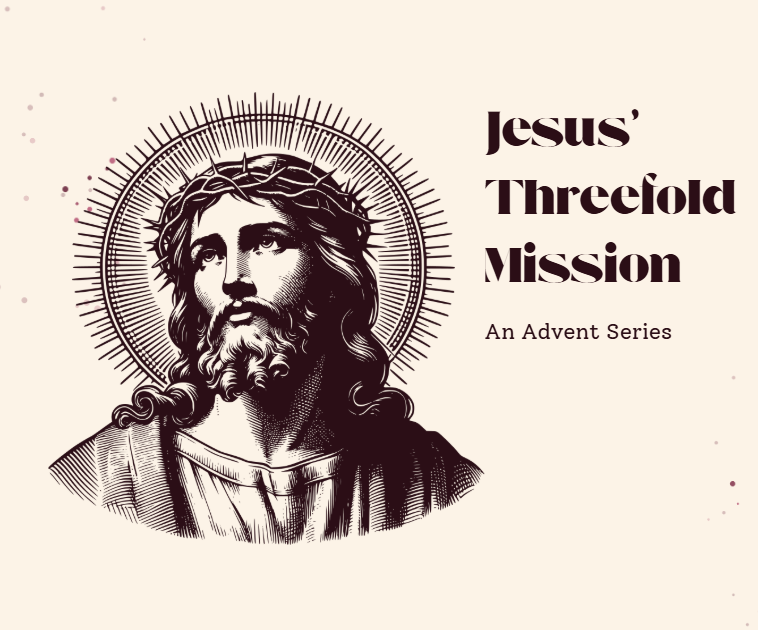
In the third and final Advent meditation, we go to Jesus’ trial before Pilate. To prepare us to celebrate the moment of Jesus’ birth, we fast forward to the moment before his death. This make sense, because in this conversation with Pilate we hear from Jesus’ mouth himself the reason why he came in the first place. “My kingdom is not of this world […] In fact, the reason I was born and came into the world is to testify to the truth. Everyone on the side of truth listens to me” (from John 18:36,37)
Jesus’ statement, however, has proven confusing to many honest Christians. To show you what I mean, let me put on the hat of an annoying nitpicky pastor. I recently received a Christmas card with a well-intentioned message on the cover, but one that was biblically wrong. The friend that got the card for my family had nothing but the best in mind, and only wanted to share their Christmas joy and lighten up our day. It did exactly that! By no means do I want to criticize my friend’s good intention. But the message on the cover was just plain wrong. It said, “Jesus did not come to be a king, but a servant.” Now, that sounds nice. It even sounds biblical! But you know very well that just because something sounds biblical, it doesn’t mean that it is.
Jesus did come to be a king. In the first chapter of Hebrews, the author goes to great lengths to show that Jesus is a fulfillment of God’s promises to establish an eternal kingdom. And in Psalm 2, God the Father says, “I have installed my king on Zion, my holy mountain” talking about the coming of the Son of God. Jeremiah prophecies the Messiah as a Righteous King (Jeremiah 23:5-6). Daniel 7:13-14 portrays the Messiah as the Son of Man who rules with an eternal rule. Isaiah 9:6-7 tells us of the child, the Son who will rule both as King and as God.
So, we can be okay with saying that Jesus did indeed as a King. But my guess is that you had some notion of that already. My friend that bought the card would probably agree with everything we’ve said thus far too. That Jesus is King, and that he has a kingdom, is not a foreign concept to anyone who has been to church longer than five minutes. Next Sunday, notice when we end our prayer to Jesus with the thought that he “lies and reigns with the Father and the Holy Spirit, one God, now and forever.”
So when Jesus says to Pilate, “My kingdom is not of this world,” we say, “Yeah.” Jesus is a King. Jesus has a kingdom. But there’s another misunderstanding that is even more dangerous. It’s in that word “of.” Jesus’ kingdom doesn’t belong to this world. It is not “of” it. But sometimes I wonder if we start to think that Jesus means, “My kingdom has nothing to do with this world.” As if to say, “So do what you want, Pilate. I don’t care. Kill me if you want. My kingdom lives on.”
The “other-worldliness” of Christ’s kingdom becomes an excuse, an attitude, a lifestyle, which sets our spiritual life apart from our “real” lives – as if our faith in Jesus pertains only to matters of spiritual contemplation; as if Jesus only matters to you in terms of how to get to heaven; as if Jesus is so busy preparing a place for you (John 14:1-4) that he doesn’t really have time to pay attention to what’s happening in your life right now. So if you’re going through something, you better tough it out or figure it out, because Jesus has bigger fish to fry than to help you with your silly little problems.
If Jesus were saying, “My kingdom has nothing to do with this world,” he would be instituting a Zen attitude of detachment from reality, and then we would be expected to somehow follow. But nothing could be further from the truth of what Jesus was saying.
“My kingdom is not of this world,” means, “My kingdom doesn’t work the way the world’s kingdoms work. My kingdom isn’t concerned with the same stresses the kingdoms of this world are concerned with.” Worldly kingdoms are about power – obtaining it, keeping it, finding ways for it to flourish. Worldly kingdoms are about winning people’s good opinion, about making good economic decisions, about striking the right deals to keep peace.
Jesus’ kingdom is nothing like that. It is not obsessed with power, because he already has all of the power that can be amassed. He is it. As the eternal Son of God, he has always ruled and reigned over everything. He never could have gained any more power for himself – so nothing in his kingdom is done in order to secure power or win it. Jesus is never afraid of losing power, because nothing can threaten it. Not even crucifixion.
Jesus’ kingdom is not about good economics, trying to win people’s favor by making groceries cheaper. Jesus’ kingdom makes no economic sense if you think about it. He, the king, pays everything. You, the subject, pay nothing. He, the king, sacrifices everything to bring you into his kingdom. You, the subject, do nothing but win.
Here, in this lesson, Jesus the King stands before Pontius Pilate. Pilate thinks he holds Jesus’ fate in his hands. Pilate thinks he has to make a decision, to use his authority to render a verdict. Pilate is at ease, because Jesus is no threat to him. But Pilate is concerned about how people will react to Jesus’ death sentence. Pilate has all the concerns of an earthly king – the concerns of a king “of this world.” Jesus says, “My kingdom is not of this world,” as the one who is really in control. Jesus’ kingdom has never stopped, from eternity and into eternity. Even when Jesus gave up full use of his divine power as king, he did not cease to be king. That means that Pilate stands before the King of the Universe and thinks he has the power to change Jesus’ fate. No, this moment itself is part of Jesus’ kingdom: a kingdom of strength hidden in weakness, of power hidden in humility, of mighty warfare clothed in acts of submission – and moments later, it becomes a kingdom of salvation and victory veiled in suffering and defeat. Jesus’ kingdom is most clearly seen at his cross: Where divine majesty, authority, and power, reveal itself in submission, suffering, and condemnation. To understand your king who came to you in the manger, look to the cross, where he defeats our enemies once and for all.
Jesus’ kingdom does not operate the way a worldly kingdom does, but that doesn’t mean it is completely separate from this world. In the hospital room, Jesus continues to reign. In the marriage counseling session, Jesus continues to reign. In the principal’s office, Jesus continues to reign. Along the fault lines of war-torn nations, Jesus continues to reign. At the graveside of one you’re going to miss dearly, Jesus continues to reign. Because Jesus’ kingdom is one of unseen victory, even when all signs are pointing to defeat. Jesus’ kingdom is one of his unseen presence with you, even when you feel most alone. Jesus’ kingdom is one of undeserved grace and love, even when you feel most unlovable.
If you want one more picture of how unworldly Jesus’ kingdom is: look at its weapons, its tools. Through a simple sprinkling of water, a person’s heart is forever changed as they go from death to life. Through a small bite of bread and sip of wine, your sins are forgiven and your unity with God re-established. Through the simple sharing of Scripture, bonds are tightened, and the Holy Spirit continues to shape your mind and thoughts. This is how Jesus reigns: through the means of grace. Because he’s not just making citizens for this life, nor for the next election: he’s making citizens for eternity. That means wherever the gospel is, there is the kingdom of Jesus. Wherever the body of Christ assembles around Word and Sacrament, Jesus is reigning through his kingdom of grace. Wherever sinners are set free from the guilt of sin by our sharing of forgiveness in Christ’s name, there is the kingdom!